Threshold ramp made to measure also: Door threshold ramp, Threshold bridge, Garage ramp
Bent ramp with a slip-resistant chequered walking surface and a vertical stop at the threshold. Enter the dimensions, check the gradient, order. Designed for full-surface support – with a base (e.g. a wedge of wood or hard rubber) the ramp also carries heavy loads.
- Instant price online
- Delivery time in the calculator
- Free collection in Frankfurt
- In-house production
Example: Threshold ramp: Length in the direction of travel 400, Threshold height 40, Front run-on 30 (outside dimensions, mm), Aluminium chequer plate light · 3.5/5.0 mm, Width 800 mm, 1 piece: Price in the calculator
Gradient approx. 10 %, 5.7°
Enter the dimensions: the price appears instantly, from 1 piece.
- Designed for full-surface support – with a base (e.g. a wedge of wood or hard rubber) the ramp also carries heavy loads.
- The calculator shows the gradient in per cent and degrees; flatter is easier to roll over.
- The chequer pattern is on the walking surface. The stop stands vertically in front of the threshold.
- Side upstands and drill holes are not included.
- Guide value for deflection: chequer plate calculator at /en/calculators/chequer-plate.
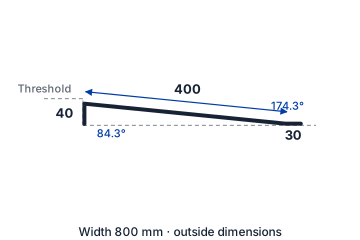
How to measure
- Threshold height: measure from the floor in front of the threshold to its top edge.
- Choose the length in the direction of travel: the longer, the flatter. The calculator shows the gradient.
- Width: measure the clear door width or the width of the threshold.
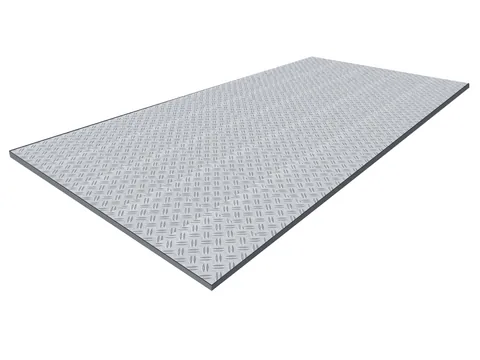
Use: bridging a threshold
The threshold ramp bridges door thresholds at front and patio doors, the step into the garage or the edge of the garden shed. Sack trucks, trolleys, lawnmowers and wheelie bins roll over the edge without a jolt.
Gradient: the calculator shows the gradient for your dimensions in per cent and degrees. The longer the ramp in the direction of travel, the flatter and easier to roll over it is. With a 40 mm threshold, a 400 mm length gives around 10 %, an 800 mm length around 5 %.
Aluminium chequer plate is grippy, light and rust-free. Simply lift the ramp away when needed, for example for sweeping or in winter.
Frequently asked questions
Which gradient makes sense?
The flatter the ramp, the easier it is to roll over. For trolleys and sack trucks, choose the length as long as the space in front of the threshold allows. The calculator shows the gradient in per cent and degrees for every input. Short, steeper ramps suit thresholds of just a few centimetres.
How do I measure correctly?
Threshold height: measure from the floor in front of the threshold to its top edge. Choose the length in the direction of travel: the longer, the flatter. The calculator shows the gradient. Width: measure the clear door width or the width of the threshold. All dimensions are outside dimensions.
Why chequer plate?
The chequer pattern breaks up the film of water and gives the walking surface grip, even when wet. Aluminium is light, does not rust and needs no maintenance: simply rinse off dirt with water. Choose light (3.5/5.0 mm) or medium (5.0/6.5 mm); the thickness is given as base/overall. The chequer plate calculator gives a guide value for deflection.
How is the ramp fixed?
The ramp lies loose in front of the threshold. Designed for full-surface support – with a base (e.g. a wedge of wood or hard rubber) the ramp also carries heavy loads. The vertical stop holds it in position; the front run-on lets the leading edge lie flat. Drill holes for a fixed screw connection are not included in this calculator; use the part designer for that or send us an enquiry.