Aluminium chequer plate cut to size: from 1 piece
Choosing chequer plate: base thickness, pattern and visible side →
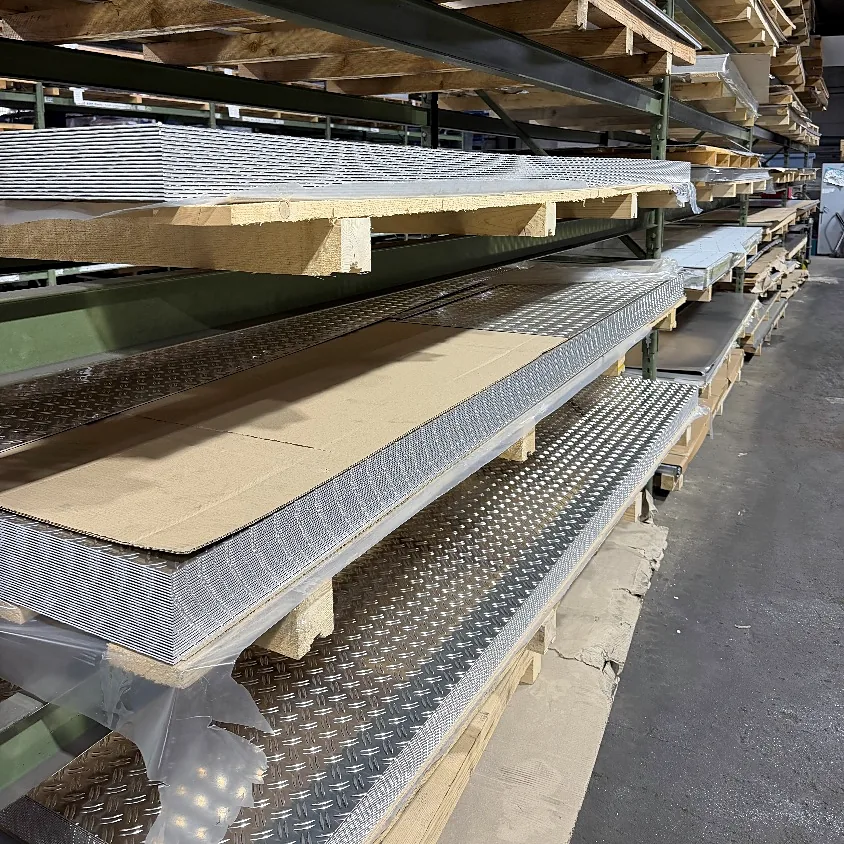
Slip-resistant tread surface with duet embossing.
Calculating price
- Cutting in Frankfurt from 1 piece, DIN ISO 2768-m
- Free collection or shipping, delivery time in the basket
- Inspection certificate 3.1 on request, selectable in the basket
Price example 500 × 500 mm, 1 piece, including order fee: in the calculator
At a glance
- Thicknesses
- 2.0/3.5, 2.5/4.0, 3.5/5.0, 5.0/6.5, 8.0/9.5 mm
- Sheet formats
- 2,000 × 1,000 mm · 2,500 × 1,250 mm · 3,000 × 1,500 mm
- Cut-to-size
- square to size, from 1 piece
- Recycling
- Metal, fully recyclable
Uses
- Platforms, steps and walkways
- Vehicle bodies and loading areas
- Workshop and machine enclosures
- Access panels and covers in walk-on areas
- Threshold ramp made to measure
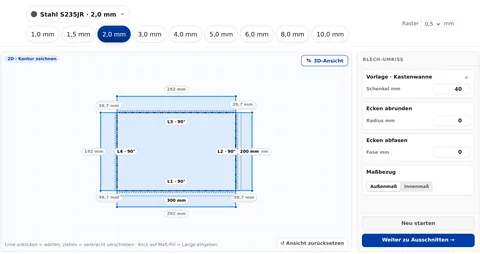 Your own shape? Draw a partHoles, cut-outs and bends in the part designer. Instant price, from 1 piece.
Surfaces compared · Calculate weight· Chequer plate load calculator
Thicknesses
| Thickness | Weight | 500 × 500 mm, 1 piece | Sheet formats |
|---|---|---|---|
| 2.0/3.5 mm | 5.78 kg/m² | Price | 2,000 × 1,000 mm · 2,500 × 1,250 mm · 3,000 × 1,500 mm |
| 2.5/4.0 mm | 7.22 kg/m² | Price | 2,000 × 1,000 mm · 2,500 × 1,250 mm · 3,000 × 1,500 mm |
| 3.5/5.0 mm | 10.11 kg/m² | Price | 2,000 × 1,000 mm · 2,500 × 1,250 mm · 3,000 × 1,500 mm |
| 5.0/6.5 mm | 14.45 kg/m² | Price | 2,000 × 1,000 mm · 2,500 × 1,250 mm · 3,000 × 1,500 mm |
| 8.0/9.5 mm | 23.11 kg/m² | Price | 2,000 × 1,000 mm · 2,500 × 1,250 mm · 3,000 × 1,500 mm |
Prices net, plus VAT and shipping; material, cutting and set-up are included in the unit price.We cut your size from these sheets; the largest part is determined by the largest format.
Properties and data sheet
- Designation
- Chequer plate in AlMg3, Duett embossing (two ribs per field)
EN AW numbers explained - Density
- 2.7 kg/dm³
- Thicknesses
- 2.0/3.5, 2.5/4.0, 3.5/5.0, 5.0/6.5, 8.0/9.5 mm
- Processing
- Laser cutting, bending, deburring
Chequer plate is aluminium sheet with a rolled-on diamond pattern. The raised ribs break the water film and increase grip. That makes it the standard material for floors, steps and treads that are walked or driven on.
Properties
- Slip-resistant surface thanks to Duett embossing
- The total height is stated: base sheet plus embossing
- Light, corrosion-resistant and low-maintenance
- The pattern is directional: note the laying direction for several plates
Surface finish
Mill-finish embossed surface. The underside is smooth and suitable as a bonding or bearing surface.
Design rules and bending
Bending is possible; the base sheet, not the total height, is decisive for the calculation. For visible parts, make sure the pattern is on the outside.
| Thickness | Minimum flange | Inside radius | Hole to bend edge |
|---|---|---|---|
| 4 mm | 20.7 mm | 4 mm | 18.1 mm |
| 5 mm | 20.7 mm | 6.5 mm | 18.1 mm |
All design rules Aluminium → ·Design guidelines → · Bend radius and minimum flange →
Cutting methods and tolerances
We cut rectangular blanks on the guillotine shear. DIN ISO 2768-m applies to length and width; the cut edge is sheared, and a slight roll-over and a burr are normal in production. We laser-cut parts with cut-outs, holes or free contours.
Typical applications and bent parts
- Platforms, steps and walkways
- Vehicle bodies and loading areas
- Workshop and machine enclosures
- Access panels and covers in walk-on areas
Bent parts to size from Aluminium chequer plate
From our production in Frankfurt
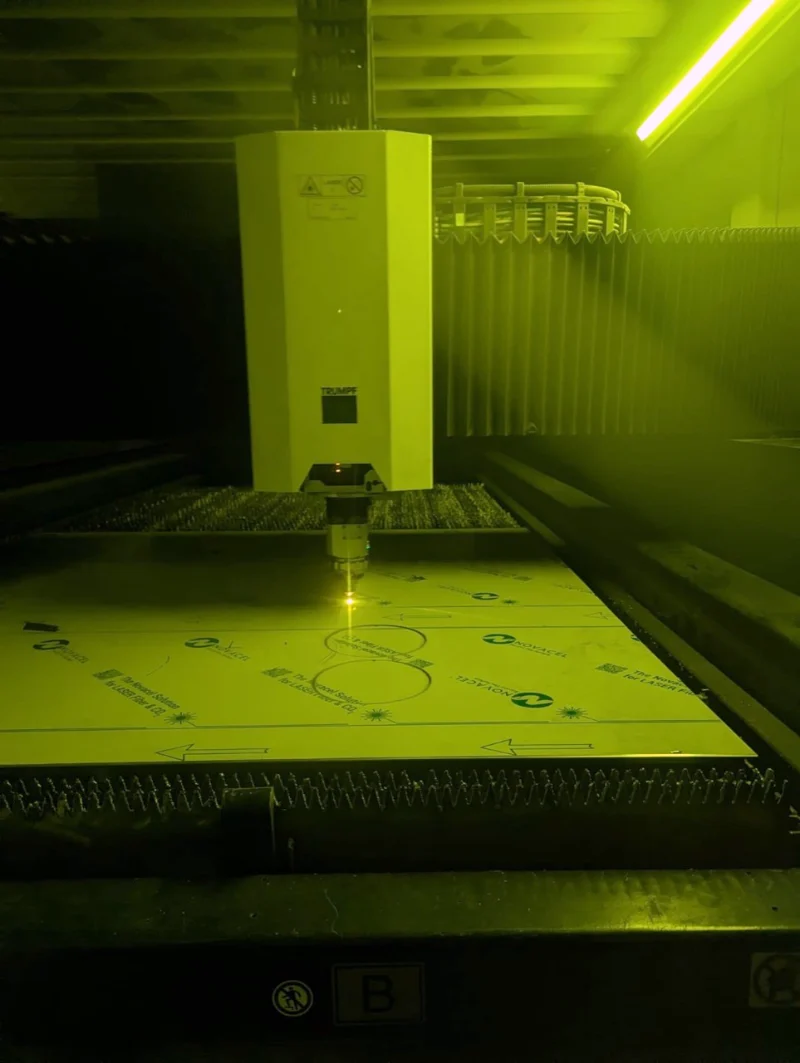
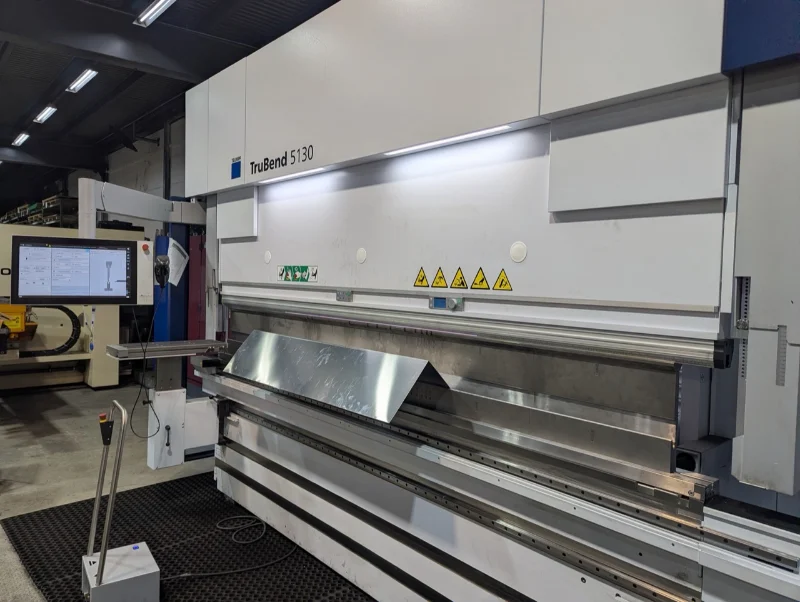
We cut, laser and bend your sheet in-house, on Hanauer Landstraße.
Questions
What does 2.0/3.5 mm mean for chequer plate?
The first number is the base thickness of the sheet, the second the total thickness across the ribs. For strength and weight, the base thickness is what mainly counts. We supply 2.0/3.5, 2.5/4.0, 3.5/5.0, 5.0/6.5 and 8.0/9.5 mm.
Which chequer pattern does the sheet have?
Duett: two elongated ribs per field, alternately crosswise to each other. The pattern is the most widespread on floors, steps and ramps and is slip-resistant in all directions.Sheet metal range.
Which thickness do I need for a floor, step or trailer?
That depends on the span and load. The chequer plate calculator gives a guide value for the deflection of your plate. For covers and cladding 2.0/3.5 mm is usually sufficient; for floors and steps choose rather 3.5/5.0 mm or more.Sheet metal range.
Can I order chequer plate bent?
Yes. As a bent part to your flange dimensions or as a ready-made threshold ramp. You set the visible side with the ribs in the configurator and see the price immediately.
How large can my blank be?
Up to the sheet size of 3000 × 1500 mm. We cut from sheets of 2000 × 1000, 2500 × 1250 and 3000 × 1500 mm, from 1 piece.
Other Aluminium sheets
- Aluminium AlMg1 anodised E6/EV1 (natural)
- Aluminium AlMg3
- Aluminium AlMg4.5Mn0.7 (EN AW-5083) H111
- Aluminium Al 99.5 hammered finish H14/24
- Aluminium sheet painted anthracite RAL 7016
- Aluminium sheet painted white RAL 9016
Related articles
Go to the magazine →- Materials · 1 min Choosing chequer plate: pattern, base thickness and visible side Two thickness values, one textured surface: what matters when cutting and bending chequer plate.
- Materials · 3 min Hammered aluminium sheet: production, cutting and painting Embossed pure aluminium with a lively surface: how hammered sheet is made, what it is suited to, and what to watch out for when cutting and painting.
- Materials · 3 min Aluminium: properties and alloys What makes aluminium special, how the alloy groups 1000 to 7000 differ, and which grade suits sheet, profile or turned part.
All materials for sheet metal cutting → · Materials at a glance · Holes or cut-outs: Part designer